These are some reasons why Appelpy adds so much more to the vanilla Python data stack:
General principles
- Fluent interface and API design make it easier to build pipelines for modelling & data pre-processing.
- Appelpy is a more accessible Python library for Stata users, by having a simple syntax and having most functionality rely on a fitted model object, while realising the benefits of object-oriented programming.

 : click the badge to see a demonstration of model pipelines with Appelpy.
Data transformation
- Useful encoders for transforming datasets, e.g.:
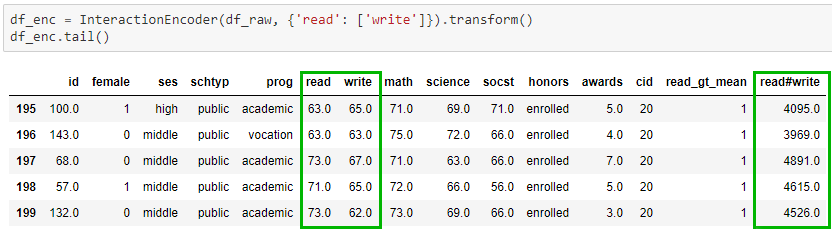
DummyEncoder: encode dummy columns from variables based on different policies for handling NaN values.InteractionEncoder: encode columns (in a batch) for the interaction effect between two variables.
get_dataframe_columns_diffmethod makes it easier to compare the columns between two dataframes when building pipelines for transforming data.
Exploratory data analysis (EDA)
- One method to examine all
statistical_momentsin a dataset: mean, variance, skewness and kurtosis. - Correlation heatmap plot with triangular matrix to maximise the data–ink ratio.
Model estimation
Model objects take on a special importance in Appelpy. More attributes and methods are available through these model objects. These are examples of what model objects contain:
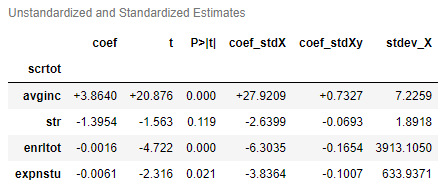
- Standardized model estimates (Beta coefficients):
model.results_output_standardized. - Standardized
yandXvalues. - Access the main metrics of a model via
model.model_selection_stats, e.g. Root MSE for OLS models. - Odds ratio available for
Logitmodels.
Model diagnostics
It's easy enough to fit a model in Statsmodels. Where Appelpy shines is the ability to do diagnostics using only the model object, instead of having to call multiple methods scattered across a library. These are some diagnostics available:
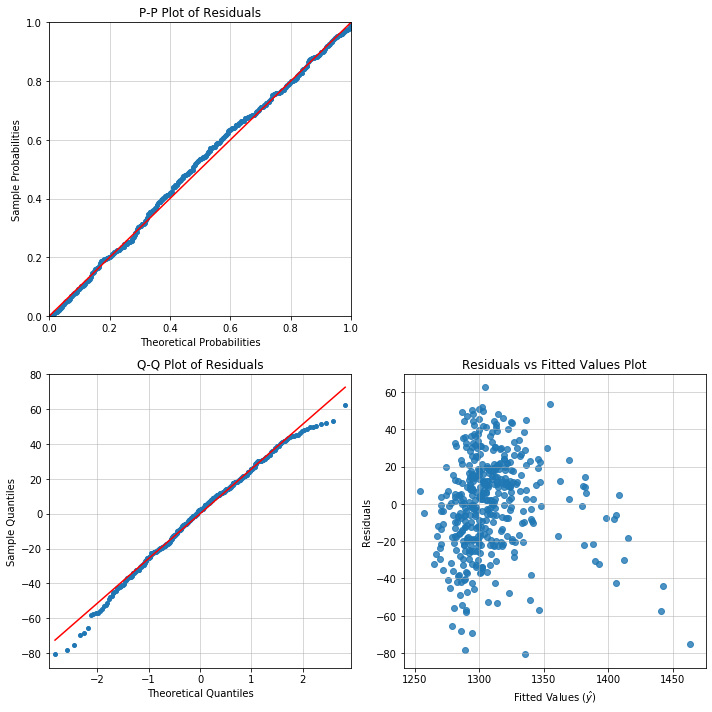
- One method for calling diagnostic plots to assess whether OLS assumptions hold in a model, e.g.
model.diagnostic_plot('rvf_plot'). The plots are similar to commands available in Stata, but here they are accessible within the Appelpy OLS model object. BadApplesclass does a decomposition of influence analysis into three parts: leverage, outlier and influence measures. The leverage vs residuals squared plot (similar to Stata'slvr2plot) can also be called from an instance of the class.- Identify extreme observations in a model based on common heuristics.
- Perform diagnostics not implemented in the main Python libraries, e.g. studentized Breusch–Pagan test of heteroskedasticity.
- Joint hypothesis testing, using built-in Python data structures (lists & dicts).
Model usage
- Model prediction methods have the option to return predictions only for observations that are 'within sample'.